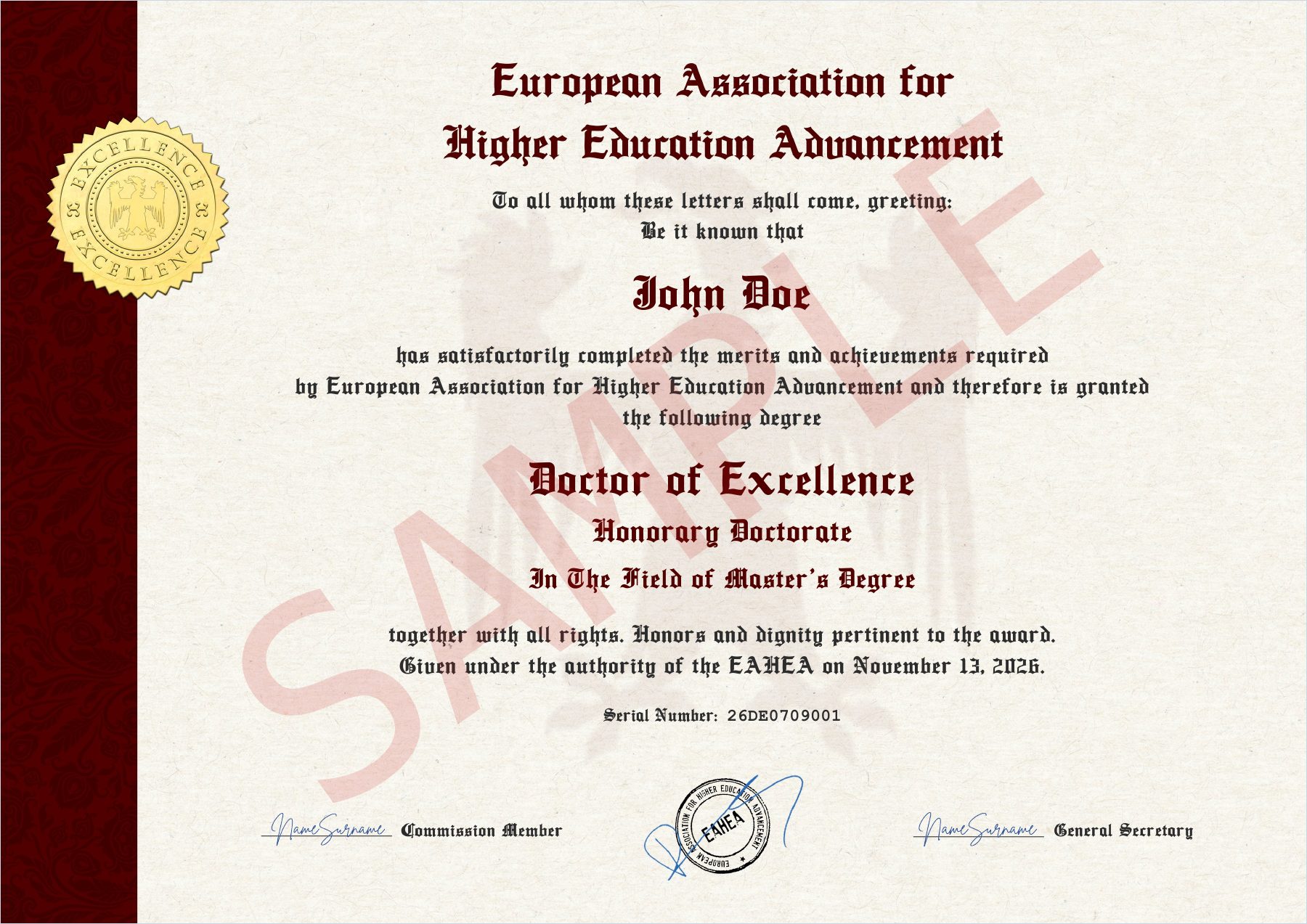
Doctor of Excellence - Honorary Doctorate (Doctor Excellentiae - Honoris Causa)
A Recognition of Professional Excellence
The Doctor of Excellence is a professional recognition that provides an independent quality assurance reference for highly qualified professionals from all fields, for those who strive for personal excellence, and who becomes a motivating example in their communities. The Doctor of Excellence (Honorary Doctorate) is a recognized mark of professional excellence and ability, outstanding professional career, services to humankind, and international achievements.
This prestigious award is not given at the end of a course or a training, and it is not given to everyone: it is granted only after a detailed review and evaluation of the supporting documents of each candidate, to the individuals who truly deserve it.
The Doctor of Excellence Honorary Doctorate
A Doctor of Excellence (in English) or Doctor Excellentiae (in Latin) is not an academic degree, consequently, the usual academic requirements of a doctorate are waived. The Doctor of Excellence is an honorary award. It is not an earned research doctorate, and the holder never presents it as one.
Recipients of an honorary doctorate such as the Doctor of Excellence may if they wish adopt the title of “doctor”. Whether and how an honorary title may be used is a matter of personal choice and of the law and custom of the country where it is used. The recipient always makes clear that the award is honorary. For example:
- Dr. Anna Brown (D.Hon.Ex.)
- Dr. Anna Brown, Doctor of Excellence (H.C.)
- Dr. Anna Brown, Doctor of Excellence (Honoris Causa)
- Hon. Dr. Anna Brown, Doctor of Excellence
- HonD. Anna Brown, Doctor of Excellence
How Is the Doctor of Excellence Eligibility Evaluated?
The minimum age to apply for the Doctor of Excellence is 30 years (for bachelor graduates, 25). For the evaluation of the candidate, to validate the admissibility to the Doctor of Excellence award, the commission established a standard based on the HPS™ (EAHEA Honorary Point System). Eligibility is based on the critical reading of the candidate’s Curriculum Vitae. To obtain the Doctor of Excellence, at least 120 HPS™ must be obtained. To avoid discrimination of any kind, the commission assesses the merits of the candidate concerning any area of knowledge, art, culture, professions, science, sport, without any social, religious, political, or citizenship discrimination.
The HPS™ are assigned based on the candidate’s CV without distinction of the cultural area and can be assigned for human, social, artistic, literary, scientific, technological, literary merits. Reaching the necessary HPS™ does not oblige European Association for Higher Education Advancement to confer the Doctor of Excellence Honorary Doctorate.
Some examples of distribution of credit points based on the interpretation of the CV and documentary evidence:
- Age: 15 to 35 HPS™, Divide age by 2
- Leadership: 5 to 20 HPS™, 1 HPS™ per year in managerial positions
- Doctorate Education: 30 HPS™ for each doctorate degree
- Postgraduate Education: 20 HPS™ for each postgraduate degree
- Bachelor’s Degrees: 10 HPS™ for each bachelor degree
- Associate’s Degrees: 5 HPS™ for each associate degree
- Professional Licenses or Certifications: 1 to 5 HPS™ for each
- Instruction, Teaching and/or Academic Experience: 1 to 5 HPS™ for each
- Honors, Awards, and Other Recognition: 1 to 5 HPS™ each
- Publications, Books, Research and Articles: 1 to 5 HPS™ for each
- Social Assistance and Humankind Services: 5 to 20 HPS™
- Other Professional and/or International Achievements: 5 to 20 HPS™
- Language Skills: 5 to 10 HPS™
- Digital Skills: 5 to 10 HPS™
Costs & Procedures for the Doctor of Excellence Award
The steps for the conferment of a Doctor of Excellence are:
- Apply online, name your field of excellence (one specialization field only), upload your Curriculum Vitae and your documents, and pay the whole price at once when you apply.
- The EAHEA Secretary checks your initial eligibility and endorses the application.
- Your documents are distributed among the Commission members, who normally answer within two to four weeks.
- The award is conferred by the majority of the votes of the EAHEA President, the EAHEA Secretary and one member of the Commission (if the votes are equal, the decision for which the EAHEA President voted prevails), which the EAHEA Secretary registers.
- The Doctor of Excellence will not be awarded until the required fees have been paid.
- The Doctor of Excellence Award is conferred in the form of two diplomas: The Doctor Excellentiae (Latin version) and the Doctor of Excellence (English version).
What Does the Doctor of Excellence Give You?
The Doctor of Excellence (Honorary Doctorate) turns a distinguished career into a documented, independently evaluated and verifiable credential. For professionals who have achieved remarkable results in their field, it is a clear way to document their accomplishments after an independent evaluation by an international association.
Support for extraordinary ability visas, residence and work permits: Many countries, including the United States, the United Kingdom, Canada and many European countries, offer visas, residence permits and work permits for people of extraordinary ability, and ask applicants to document outstanding ability in a specific field. A Doctor of Excellence, awarded after an independent evaluation of your Curriculum Vitae and documents, gives you a record that can help you to show your standing in your field when you document your extraordinary ability for your visa, residence permit and work permit applications (decisions on visas and permits are made only by the authorities of each country, and EAHEA does not guarantee any visa, permit or other result).
Two diplomas and a verification you can share: The award is conferred as two diplomas, the Doctor of Excellence (English) and the Doctor Excellentiae (Latin), together with a Degree Verification Certificate. Employers, institutions and officials can confirm your award with EAHEA, which gives your profile credibility in international applications.
The title “Doctor” and a stronger professional profile: Recipients may use the title “Doctor” with the honorary status stated clearly. The award strengthens your standing for consulting, speaking, board and advisory roles, academic and business partnerships, publications and media appearances.
A fair evaluation for every field: The usual academic requirements of a doctorate are waived. The commission assesses your merits in any area of education, knowledge, art, culture, profession, science or sport, without any social, religious, political or citizenship discrimination.
A simple, fully online process: You apply and send your documents in electronic format, and the Commission gives its response in two to four weeks. As a recipient you also join the EAHEA Certified Members Directory and receive EAHEA news alerts, the newsletter and discounts for EAHEA sponsored events.
What Do You Get upon Doctorate Certification?
- Doctor of Excellence Certificate (English)
- Doctor Excellentiae Certificate (Latin)
- Degree Verification Certificate
- Certified Members Directory Listing
- E-delivery News Alerts and Newsletter
- Discounts for all EAHEA sponsored events